Introduction
Robotic, monotone TTS is dead. Today’s AI voices laugh, whisper, pause for effect, and clone a human voice from just a few seconds of audio — and most people still don’t know it’s possible.
Whether you’re a podcaster who needs studio-quality narration without hiring a voice actor, a developer building a real-time voice agent, or someone who just wants their PDFs read aloud on the commute, there’s a TTS tool built exactly for that job.
The catch? The space spans everything from $11/month consumer apps to free, self-hosted AI models — and picking the wrong one means overpaying or underdelivering.
We tested and compared the best text to speech tools, from polished apps to cutting-edge open-source models, so you can pick the right voice for your needs.
Disclosure: This post may contain affiliate links. This means if you click on one of the links and purchase anything I may receive some affiliate commission at no extra cost to you. Thanks in advance for your support.
#1. Elevenlabs TTS
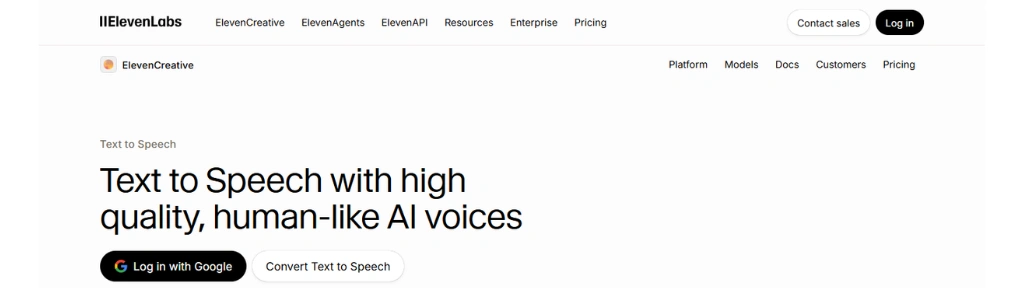
Best for creators, developers, and studios who want the most realistic, emotionally expressive AI voices on the market — with full creative control over delivery.
1. What it specializes in
ElevenLabs offers text to speech with high quality, human-like AI voices, built for a wide range of use cases from AI agents to audiobooks, voiceovers, gaming, podcasts, and accessibility.
2. Voice quality & realism
This is ElevenLabs’ calling card. Its voice AI responds to emotional cues in text and adapts its delivery to suit both the immediate content and wider context, achieving a level of emotional nuance that’s widely regarded as best-in-class.
3. Voice library & customization
Access a library of 10,000+ human-like voices spanning narration, advertisement, characters, conversational, and social media styles, plus the ability to clone or design a voice with full control.
4. Pricing model
Free starts at $0/month with 10k credits. Starter is $6/month (30k credits, commercial license, instant voice cloning). Creator is $11/month (121k credits, professional voice cloning). Pro is $99/month (600k credits, higher-quality audio output). Business plans scale up to $990/month for teams.
5. Who it’s best for
Developers building conversational agents, game studios, audiobook producers, video creators, podcasters, and accessibility teams — essentially anyone who needs production-grade voice quality, not just a casual reader.
6. Ease of use & interface
Available on the web, mobile, and via APIs or SDKs, with a no-code Studio editor for non-developers and full API access for technical integration.
7. Emotional range & control
Eleven v3 is the most advanced, expressive model with audio tags for precise emotional control — supporting dramatic delivery, pacing, tone, and style exaggeration that few competitors match.
8. Output flexibility & integrations
Generate speech in over 70 languages and a wide range of accents, with multiple models optimized for different needs — Flash v2.5 offers ultra-low latency (~75ms) for real-time apps, while Multilingual v2 favors long-form quality.
9. Limitation
The free and entry tiers carry tight credit caps (10k–30k credits), and the per-character pricing can scale quickly for high-volume users — heavy podcasters or audiobook publishers will likely outgrow Starter fast.
10. Verdict
⭐⭐⭐⭐⭐ — The gold standard for voice realism and emotional depth. If sound quality is your top priority over price, ElevenLabs is hard to beat — listen to a voice sample before choosing your plan.
#2. Fish Audio TTS
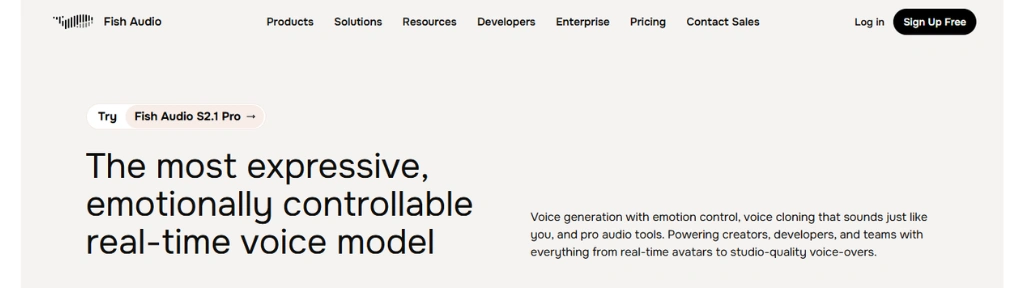
Best for creators, developers, and indie hackers who want a massive open voice library and budget-friendly pricing — without sacrificing emotional expressiveness.
1. What it specializes in
Fish Audio is a text-to-speech platform built around natural-sounding voice generation, with strong use-case coverage across audiobooks and narration, video narration, and podcast production.
2. Voice quality & realism
Fish Audio claims to have the most realistic human voices online, powered by advanced AI technology, creating speech indistinguishable from real humans — a bold claim, though independent reviewers generally rate it as a strong, credible ElevenLabs alternative rather than a clear leader.
3. Voice library & customization
The platform hosts over 2,000,000 community-uploaded voices, and instant voice cloning needs as little as 10 seconds of audio to create a usable clone — one of the lowest sample requirements in the industry.
4. Pricing model
Free includes 8,000 credits/month (up to 7 minutes of generation). Plus is $11/month (250,000 credits, ~200 minutes, commercial use allowed). Pro is $75/month (2,000,000 credits, ~1,620 minutes, 3 team seats). Max scales to $749/month for large teams.
5. Who it’s best for
Startups, students, audiobook creators, and chatbot developers looking for an affordable, high-volume TTS option without enterprise pricing.
6. Ease of use & interface
A simple, browser-based playground lets you type text and generate audio instantly, with a separate API offering ultra-low latency, comprehensive SDKs, and simple REST endpoints for developers.
7. Emotional range & control
60+ emotion tags and sub-300ms streaming latency let you inject specific emotional cues like anger, whispering, or laughter directly into the text — unusually granular tag-based control for the price point.
8. Output flexibility & integrations
Automatic support for 8 languages with native accents, plus pro controls to precisely adjust speed, volume, and raw model parameters for fine-tuned output.
9. Limitation
The free plan is for personal use only — commercial use and monetization require upgrading to a paid plan, and language support (8) is notably narrower than rivals like ElevenLabs (70+).
10. Verdict
⭐⭐⭐⭐ — An excellent value-for-money pick, especially for creators who want a huge, community-driven voice library and granular emotional tags without enterprise pricing. Limited language support is the main trade-off versus pricier competitors.
#3. Speechify TTS
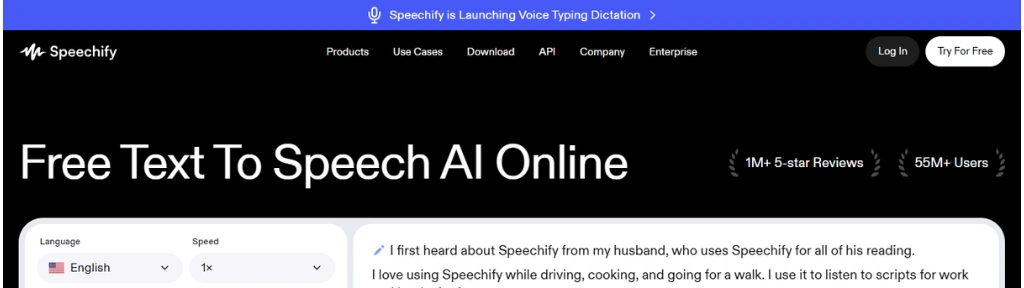
Best for readers, students, and accessibility users who want any text — PDFs, articles, books — read aloud in a voice that sounds genuinely human.
1. What it specializes in
Speechify is a Voice AI Assistant that lets you listen, write, and get answers — primarily known for reading PDFs, docs, web pages, and books aloud, with secondary tools for podcasting and dictation.
2. Voice quality & realism
The AI voices are now indistinguishable from human voices on the paid tier — a major leap from older robotic TTS engines, and arguably the platform’s biggest selling point.
3. Voice library & customization
Speechify offers over 1,000 natural-sounding text-to-speech voices in more than 60 languages, plus voice cloning that lets you upload or record a speaker’s voice (with permission) and generate a clone of it.
4. Pricing model
The Free plan includes 10 robotic-sounding voices at up to 1.5x speed. Premium is $29/month and unlocks 1,000+ natural voices, 60+ languages, 5x speed, AI summaries, voice typing, AI podcasts, and a voice AI assistant.
5. Who it’s best for
Students, professionals, educators, and individuals with reading challenges like dyslexia — anyone who wants to consume written content faster, hands-free.
6. Ease of use & interface
Speechify works across the web, iOS, Android, Mac, Windows, Chrome, and Edge — genuinely plug-and-play, with no technical setup required for casual users.
7. Emotional range & control
The API includes instant voice cloning, language support, streaming, SSML, and emotional controllability — strong control for developers, though casual app users get less granular tuning.
8. Output flexibility & integrations
It supports PDF, EPUB, DOCX, XLSX, and TXT files, web links, scanned pages, and typed text, with a Text to Speech API for developers wanting to embed voices into their own apps.
9. Limitation
The free plan is genuinely limited — robotic voices and capped speed mean most readers will need Premium to access the “human-like” experience that makes Speechify famous.
10. Verdict
⭐⭐⭐⭐½ — The most consumer-friendly TTS app for everyday reading, with genuinely impressive voice realism. Best paired with a quick listen to a voice sample before committing.
Open Source TTS Tools
Qwen 3 TTS
Quick heads-up: Qwen3-TTS-12Hz-1.7B-CustomVoice isn’t a hosted platform — it’s a free, open-source model you self-host or run via Alibaba’s DashScope API. Worth mentioning as the experience (and audience) is very different from consumer apps like Speechify or ElevenLabs.
Best for developers and researchers who want state-of-the-art, multilingual TTS with full control — and zero per-character costs.
1. What it specializes in
Qwen3-TTS-12Hz-1.7B-CustomVoice provides style control over target timbres via user instructions, supporting 9 premium timbres covering various combinations of gender, age, language, and dialect — built for developers who want to embed high-quality TTS directly into their own apps.
2. Voice quality & realism
This is a genuine technical standout. On the multilingual benchmark, Qwen3-TTS-12Hz-1.7B-Base achieves a 0.836 Word Error Rate in English and outperforms ElevenLabs and MiniMax across most speaker-similarity metrics — a rare case of an open model beating commercial leaders on independent benchmarks.
3. Voice library & customization
The model covers 10 major languages (Chinese, English, Japanese, Korean, German, French, Russian, Portuguese, Spanish, and Italian) as well as multiple dialectal voice profiles, with 9 named speaker voices spanning Chinese (including Beijing and Sichuan dialects), English, Japanese, and Korean.
4. Pricing model
Completely free and open-source under the Apache-2.0 license — you only pay for your own compute (GPU hosting) if self-deploying, or usage-based fees if accessed via Alibaba’s DashScope API.
5. Who it’s best for
Developers, ML engineers, and researchers building custom voice products, agents, or apps — not casual creators looking for a point-and-click tool.
6. Ease of use & interface
The easiest way to use Qwen3-TTS is to install the qwen-tts Python package from PyPI, and a local Web UI demo can be launched with a single command — but this still requires comfort with Python, GPU setup, and command-line tools.
7. Emotional range & control
The model supports speech generation driven by natural language instructions, allowing flexible control over multi-dimensional acoustic attributes such as timbre, emotion, and prosody — you can literally type an instruction like “speak in an angry tone” alongside your text.
8. Output flexibility & integrations
It supports both streaming and non-streaming generation, with end-to-end synthesis latency as low as 97ms, and vLLM officially provides day-0 support for Qwen3-TTS for production-grade deployment.
9. Limitation
There’s no UI, no dashboard, and no customer support — this is a raw model file, not a product. Non-technical readers will need a wrapper service or developer help to use it.
10. Verdict
⭐⭐⭐⭐½ (for developers only) — One of the most capable open-source TTS models available, with benchmark results that rival or beat paid leaders. A poor fit for non-technical creators, but a goldmine for anyone building their own voice product.
Supertronic 3 TTS
Quick heads-up: Like Qwen3-TTS, Supertonic-3 isn’t a hosted platform — it’s a free, open-weight model designed specifically to run locally on-device, without any cloud calls.
Best for developers who want fast, lightweight, fully offline TTS that runs on a CPU — no GPU, no cloud, no per-character billing.
1. What it specializes in
Supertonic is a lightweight text-to-speech system for local inference that runs with ONNX Runtime entirely on your device, with no cloud call required for synthesis — purpose-built for on-device and edge deployment rather than cloud-hosted apps.
2. Voice quality & realism
Across measured languages, Supertonic 3 stays within a competitive WER/CER range against much larger open TTS models such as VoxCPM2, while preserving a lightweight on-device deployment path — strong accuracy for its size, though not positioned as the most expressive or emotionally rich voice on this list.
3. Voice library & customization
Supertonic 3 expands language coverage from 5 to 31 languages, and supports simple expression tags such as <laugh>, <breath>, and <sigh> for light emotional inflection alongside named voice styles.
4. Pricing model
Completely free. The accompanying model is released under the OpenRAIL-M License, with no subscription, credits, or API fees — you only pay for the hardware you run it on (and even that can just be a laptop CPU).
5. Who it’s best for
Developers building offline-first apps, embedded devices, privacy-sensitive products, or browser/edge tools that can’t rely on a cloud round-trip for speech generation.
6. Ease of use & interface
Install the Python SDK and generate speech immediately — on first run, the SDK downloads the model assets from Hugging Face, with ready-to-run Google Colab and Kaggle notebooks for quick testing. Still developer-oriented, but notably lower friction than most open TTS models.
7. Emotional range & control
Control is intentionally minimal — expression tags such as <laugh>, <breath>, and <sigh> cover the basics, but there’s no fine-grained instruction-based emotional steering like you’d get from Qwen3-TTS or ElevenLabs.
8. Output flexibility & integrations
Supertonic 3 runs fast on CPU, even compared with larger baselines measured on A100 GPU, and uses substantially less memory, and at about 99M parameters, it is much smaller than 0.7B to 2B class open TTS systems — ideal for constrained environments like mobile or browser deployment.
9. Limitation
The trade-off for that small footprint is depth — voice expressiveness and emotional range are noticeably more limited than larger models, and there’s no hosted API or UI; you’re fully responsible for deployment.
10. Verdict
⭐⭐⭐⭐ (for developers only) — One of the best lightweight, fully offline TTS options available. Not the most expressive voice on this list, but unmatched for speed, footprint, and privacy-first on-device use cases.
Kokoro 82M TTS
Quick heads-up: Like the other two HuggingFace entries, Kokoro-82M isn’t a hosted consumer platform — it’s a free, ultra-lightweight open-weight model that’s become one of the most widely deployed TTS engines in the open-source world, used by dozens of commercial APIs under the hood.
Best for developers and indie builders who want the cheapest possible TTS at scale, with proven production use across hundreds of real-world deployments.
1. What it specializes in
Kokoro is an open-weight TTS model with 82 million parameters that delivers comparable quality to larger models while being significantly faster and more cost-efficient — designed for lightweight, low-cost deployment rather than maximal expressiveness.
2. Voice quality & realism
Quality punches well above its tiny size. Despite its lightweight architecture, it delivers comparable quality to larger models, and it’s become a go-to benchmark contender — it’s used as a contender in the TTS Spaces Arena where it’s compared head-to-head against far larger systems.
3. Voice library & customization
The current v1.0 release supports 8 languages and 54 voices, a significant jump from the original v0.19 release’s single language and 10 voices — modest compared to giants like ElevenLabs, but solid for a model this small.
4. Pricing model
Free and self-hostable under Apache-2.0 licensed weights. If you’d rather not self-host, the market rate of Kokoro served over API is under $1 per million characters of text input, or under $0.06 per hour of audio output — among the cheapest TTS pricing available anywhere.
5. Who it’s best for
Developers and startups building cost-sensitive, high-volume voice features — chatbots, narration tools, or apps where margins matter more than top-tier emotional nuance.
6. Ease of use & interface
You can run a basic cell on Google Colab with just a few lines of Python and a pip install — one of the lowest-friction open TTS setups available, with sample audio and voice documentation provided directly on the model page.
7. Emotional range & control
Control is limited — Kokoro is a decoder only architecture with no diffusion or instruction-based emotional steering, so it’s better suited to clean, neutral narration than highly expressive performances.
8. Output flexibility & integrations
Kokoro has been deployed in numerous projects and commercial APIs, and is already available through providers like Replicate and DeepInfra, making it easy to integrate without managing your own infrastructure if you’d prefer a hosted option.
9. Limitation
Kokoro was trained exclusively on permissive/non-copyrighted audio data totalling only a few hundred hours — a tiny dataset compared to commercial models, which can show up as less nuance and emotional range in longer or more dramatic content. Also watch for impostor sites: fake websites masquerading under the Kokoro name are not affiliated with the real model.
10. Verdict
⭐⭐⭐⭐ (for developers only) — The best price-to-quality ratio in open-source TTS, and its widespread adoption across commercial APIs is a strong vote of confidence. Not the most expressive voice on this list, but unbeatable for cost-sensitive, high-volume use cases.
Omnivoice TTS
Quick heads-up: Like the other open-weight models on this list, OmniVoice isn’t a hosted consumer platform — it’s a free research model you self-host or run via Hugging Face Spaces. It’s also explicitly research-licensed, so worth flagging that distinction clearly for readers.
Best for developers who need the broadest language coverage of any TTS model available — with research-grade voice cloning and design control to match.
1. What it specializes in
OmniVoice is a massively multilingual zero-shot text-to-speech model supporting over 600 languages, built on a novel diffusion language model-style architecture that delivers high-quality speech with superior inference speed, supporting voice cloning and voice design.
2. Voice quality & realism
It delivers high-quality speech with superior inference speed, backed by a clean, streamlined, and scalable architecture that delivers both quality and speed — quality that holds up impressively given the sheer breadth of languages it has to cover.
3. Voice library & customization
600+ languages supported — the broadest language coverage among zero-shot TTS models — by far the widest reach in this entire roundup. Voice design lets you control voices via assigned speaker attributes like gender, age, pitch, dialect/accent, and whisper.
4. Pricing model
Completely free under an Apache-2.0 license — self-hosted, with no subscription or per-character cost. You only pay for your own compute if self-deploying.
5. Who it’s best for
Researchers, academic teams, and developers building products for underserved languages — its 600+ language coverage makes it uniquely suited to global, multilingual, or low-resource-language applications that other platforms simply can’t reach.
6. Ease of use & interface
Install the omnivoice library via pip after setting up PyTorch, with a Google Colab notebook available for quick testing — still firmly developer-territory, but well-documented.
7. Emotional range & control
Fine-grained control includes non-verbal symbols (e.g., [laughter]) and pronunciation correction via pinyin or phonemes, alongside the voice design attributes mentioned above — solid expressive control for a model this broad in scope.
8. Output flexibility & integrations
Fast inference with an RTF as low as 0.025 (40x faster than real-time) makes it well-suited to high-throughput pipelines, and state-of-the-art voice cloning quality from a short reference audio rounds out its developer toolkit.
9. Limitation
This project is intended only for academic research purposes. Users are strictly prohibited from using this model for unauthorized voice cloning, voice impersonation, fraud, scams, or any other illegal or unethical activities. This research-only framing, combined with the developer-only setup, makes it a poor fit for any commercial deployment without further legal review.
10. Verdict
⭐⭐⭐⭐ (for developers and researchers only) — Unmatched language coverage and genuinely impressive speed for its scope, but the explicit research-only disclaimer is a serious consideration before building it into any commercial product.
Coqui TTS
Quick heads-up: XTTS-v2 is another open-weight model rather than a hosted platform, though it’s notable for actually powering a commercial product (Coqui Studio/API) — making it a useful bridge between pure research models and consumer-facing tools.
Best for developers and creators who want fast, multilingual voice cloning from just a few seconds of reference audio — without paying per character.
1. What it specializes in
XTTS is a voice generation model that lets you clone voices into different languages by using just a quick 6-second audio clip, with no need for an excessive amount of training data — and notably, this is the same or similar model that powers Coqui Studio and Coqui API, so it’s been proven in real commercial deployment.
2. Voice quality & realism
XTTS-v2 brings stability improvements and better prosody and audio quality across the board compared to its predecessor, with output at a 24khz sampling rate — solid, production-grade quality for a fully self-hosted model.
3. Voice library & customization
There’s no fixed voice library — instead, voice cloning works with just a 6-second audio clip, and the model enables the use of multiple speaker references and interpolation between speakers, letting you blend voices together for custom results.
4. Pricing model
Free to self-host, though licensing is more restrictive than the other open models on this list — it’s released under the Coqui Public Model License, which has specific terms around commercial use worth reviewing before deploying at scale.
5. Who it’s best for
Developers and indie creators who need fast voice cloning across multiple languages — particularly useful for dubbing, localization, or any project where you need the same voice speaking several languages.
6. Ease of use & interface
The codebase supports inference and fine-tuning, with simple usage via the 🐸TTS API, command line, or direct model loading — genuinely one of the more approachable open TTS setups, especially with the ready-made Hugging Face Space demo to test before committing to a local install.
7. Emotional range & control
XTTS-v2 supports emotion and style transfer by cloning — rather than instruction tags, emotional delivery is inherited from whatever’s present in your reference clip, which is a more indirect but often very natural-sounding approach.
8. Output flexibility & integrations
XTTS-v2 supports 17 languages including cross-language voice cloning and multi-lingual speech generation — meaning you can clone a voice in one language and have it speak fluently in another, a standout feature for global content.
9. Limitation
17 languages is noticeably narrower than newcomers like OmniVoice (600+) or Qwen3-TTS’s broader multilingual benchmarks, and the Coqui Public Model License carries more commercial-use caveats than a straightforward Apache or MIT license — read the terms carefully before shipping a paid product.
10. Verdict
⭐⭐⭐⭐ (for developers only) — A mature, battle-tested voice cloning model with real commercial pedigree behind it. The 6-second cloning and cross-language support are genuinely impressive, but check the license terms before any commercial use.
Voxtral 4B TTS
Quick heads-up: Voxtral-4B-TTS is another open-weight model rather than a hosted consumer platform, but it’s distinct from the others on this list — it’s explicitly enterprise-positioned for voice agents, and Mistral also offers a hosted demo/API via their AI Studio for those who don’t want to self-deploy.
Best for enterprises and developers building real-time voice agents — customer support, call centers, and KYC flows — who need low latency at production scale.
1. What it specializes in
Voxtral TTS is a frontier, open-weights text-to-speech model that’s fast, instantly adaptable, and produces lifelike speech for voice agents, with named use cases spanning customer support and call center infrastructure, financial services, manufacturing, public services, compliance, supply chain, automotive, sales, and real-time translation.
2. Voice quality & realism
Voxtral TTS delivers realistic, expressive speech with natural prosody and emotional range across 9 major languages, with support for diverse dialects — explicitly positioned as enterprise-grade rather than just a research demo.
3. Voice library & customization
It ships with 20 preset voices and easy adaptation to new voices, with additional customization available through Mistral’s AI Studio for teams that want a managed voice design workflow.
4. Pricing model
Released with BF16 weights under a CC BY-NC 4.0 license — free to use, but explicitly non-commercial. Commercial deployments will need to go through Mistral’s hosted API/AI Studio instead of self-hosting the raw weights.
5. Who it’s best for
Enterprise teams and developers building production voice agents — particularly in regulated or high-stakes domains like banking KYC, healthcare, or government services where latency and reliability matter as much as voice quality.
6. Ease of use & interface
The model can run on a single GPU with 16 GB+ memory via vllm serve mistralai/Voxtral-4B-TTS-2603 –omni, with a simple HTTP client for generating speech and a ready Hugging Face Space demo for testing without any setup.
7. Emotional range & control
Emotional delivery is built into the base model rather than tag-driven — natural prosody and emotional range come out of the box across its supported languages, with voice swapping handled simply by changing the voice parameter.
8. Output flexibility & integrations
Multilingual support spans English, French, Spanish, German, Italian, Portuguese, Dutch, Arabic, and Hindi, with 24 kHz audio output in WAV, PCM, FLAC, MP3, AAC, and Opus formats — genuinely production-friendly format coverage. Benchmarks show 70ms latency at single concurrency and throughput up to 1,430 characters/second/GPU at 32 concurrent streams.
9. Limitation
The CC BY-NC 4.0 license is the biggest catch — this is explicitly non-commercial for self-hosted use, so any business wanting to deploy it in a paid product needs to go through Mistral’s official API rather than running the open weights directly.
10. Verdict
⭐⭐⭐⭐ (for developers and enterprises only) — Genuinely impressive low-latency performance built specifically for voice agents, but the non-commercial license means most businesses will end up using Mistral’s hosted API rather than the open weights themselves.
Vibevoice 1.5B TTS
Quick heads-up: VibeVoice-1.5B is another open-weight research model, not a hosted platform. It’s notable for one specific reason — it’s the only model in this list explicitly built for long-form, multi-speaker conversational audio like podcasts, but Microsoft explicitly labels it research-only with several use-case restrictions.
Best for researchers and developers experimenting with long-form, multi-speaker podcast-style audio generation — not for commercial deployment.
1. What it specializes in
VibeVoice is a novel framework designed for generating expressive, long-form, multi-speaker conversational audio, such as podcasts, from text, specifically addressing scalability, speaker consistency, and natural turn-taking — problems most single-speaker TTS models don’t even attempt to solve.
2. Voice quality & realism
VibeVoice employs a next-token diffusion framework, leveraging a Large Language Model to understand textual context and dialogue flow, and a diffusion head to generate high-fidelity acoustic details — a genuinely novel architecture built to keep speakers consistent across very long conversations.
3. Voice library & customization
There’s no curated voice catalog in the traditional sense — instead, the model’s standout feature is scale: the model can synthesize speech up to 90 minutes long with up to 4 distinct speakers, surpassing the typical 1-2 speaker limits of many prior models.
4. Pricing model
Free under an MIT license for self-hosted research use, though Microsoft is explicit that this isn’t intended for any commercial pricing model at all.
5. Who it’s best for
Researchers and hobbyist developers experimenting with podcast-style or multi-speaker dialogue synthesis — definitively not for production businesses, given the restrictions below.
6. Ease of use & interface
The model can be loaded directly via the Transformers pipeline (“text-to-speech”, model=”microsoft/VibeVoice-1.5B”), with ready Colab and Kaggle notebooks — a relatively simple setup for a model of this complexity.
7. Emotional range & control
Strength here lies less in expressive emotional tags and more in maintaining natural conversational dynamics — natural turn-taking across multiple speakers is the model’s core innovation, rather than fine-grained single-voice emotional control.
8. Output flexibility & integrations
A larger variant supports up to 32K context for ~45 minutes of generation, while this 1.5B model supports 64K context for ~90 minutes — genuinely best-in-class for long-form generation length among the models covered here.
9. Limitation
This is the most restricted model on the list. The VibeVoice model is limited to research purpose use, explicitly excluding voice impersonation without consent, disinformation or impersonation, real-time voice conversion, and any language outside English and Chinese. Microsoft does not recommend using VibeVoice in commercial or real-world applications without further testing and development, and the model embeds an audible AI disclaimer and an imperceptible watermark into every generated file.
10. Verdict
⭐⭐⭐½ (research use only) — A genuinely innovative approach to multi-speaker, long-form synthesis, but the explicit research-only restrictions, English/Chinese-only support, and mandatory watermarking make this the least production-ready model in this roundup.
Higgs audio V3 TTS
Quick heads-up: This Hugging Face Space is a free interactive demo for Higgs Audio v3 TTS, an open-weight model built by Boson AI specifically for real-time voice agents. Unlike the other HF entries, it also has an official hosted API (Boson AI) if you don’t want to self-host — though that’s currently in free preview too.
Best for developers building real-time, chat-native voice agents who need a TTS model that speaks mid-sentence, not just after the text is finished.
1. What it specializes in
Higgs Audio v3 TTS is built for voice chat — it speaks, not just reads, turning model responses into expressive conversational speech across 100+ languages, with zero-shot voice cloning and inline control over emotion, style, prosody, pauses, and sound effects.
2. Voice quality & realism
Out of the box, Higgs Audio v3 TTS reaches single-digit WER/CER on 100+ languages, and on Boson AI’s internal Higgs-Multilingual suite covering 111 languages and dialects, it reaches single-digit WER/CER on 100 languages — genuinely strong accuracy at this kind of language breadth.
3. Voice library & customization
Use a preset speaker via the voice parameter, or clone a voice from a short reference clip using ref_audio — zero-shot voice cloning from a short clip, reusable across languages without retraining.
4. Pricing model
Free either way — the weights are released for research and non-commercial use, with production, hosted APIs, or revenue-generating use requiring a separate commercial license, and the Boson API is currently free and rate-limited while reliability and quality improve.
5. Who it’s best for
Developers building real-time, conversational voice agents — customer support bots, AI companions, or any product where speech needs to flow naturally inside a live conversation rather than being generated after the fact.
6. Ease of use & interface
This specific Hugging Face Space is the simplest entry point — type text, hear it instantly, with no setup. For production, pair the weights with SGLang-Omni, a production serving stack with continuous batching for multi-codebook decoding, or call the Boson API directly via curl, Python, or TypeScript.
7. Emotional range & control
Inline control tokens cover emotion (21 types), style (singing/shouting/whispering), sound effects, and prosody — set directly inside the text stream, e.g. <|emotion:surprise|><|prosody:pitch_high|><|sfx:screaming|>, making this one of the most granular control schemes in this whole roundup.
8. Output flexibility & integrations
Audio output is 24kHz MP3 or PCM, with streaming so it speaks before the sentence is finished and benchmarked throughput of 14.74 req/s at RTF 0.262 with 16 concurrent requests on a single H100.
9. Limitation
Production, hosted APIs, or revenue-generating use requires a separate commercial license, and prohibited uses include voice cloning without consent, impersonation, fraud, election deception, and biometric surveillance. Like the other open models here, this is a developer/research tool, not a polished consumer app.
10. Verdict
⭐⭐⭐⭐½ (for developers only) — One of the most technically impressive voice-agent-focused TTS models available right now, with genuinely best-in-class latency and control. The non-commercial license is the one thing standing between this and serious production use.
Conclusion
There’s no single “best” TTS tool — it depends entirely on who you are.
If you want the most realistic, emotionally expressive voice with zero setup, ElevenLabs remains the benchmark to beat.
If you just want documents and articles read aloud effortlessly, Speechify is the most consumer-friendly pick.
Budget-conscious creators should look at Fish Audio, which delivers strong quality and a massive voice library at a fraction of the cost.
For developers, the open-source landscape has matured fast: Kokoro-82M and Supertonic-3 are unbeatable for cheap, lightweight, high-volume deployment, while Higgs Audio v3 and Qwen3-TTS lead the pack for real-time, expressive voice agents.
Just double-check licensing — several of the most powerful open models are research-only until you go through a commercial API.
Whichever you choose, listen to a voice sample first. With TTS, your ears will tell you more than any spec sheet.
It’s fascinating how far TTS technology has come; the ability to pause for effect really adds a human touch!
Robotic voices have really come a long way! It’s impressive to see how far TTS technology has evolved, especially with the ability to clone human voices from just a few seconds of audio.
The advancements in TTS are truly remarkable! The idea of using AI voices that can actually laugh and whisper adds an incredible layer of realism, making it hard to differentiate from human speakers. It’s exciting to think about the potential applications for this technology.
The capability of TTS tools to create studio-quality narration without needing a voice actor is a game changer! It’s exciting to see how these advancements open up new opportunities for content creators everywhere.