Every piece of content you publish is a bet. The best creators and marketers stack the odds by knowing what people are already searching for — before the window closes.
The right tools to find trending topics are what separate creators who consistently ride waves from those who write great content nobody reads.
But the category spans an enormous range: free real-time dashboards, AI-powered early trend engines, ecommerce competitive intelligence platforms, and question-mining tools that turn a trending keyword into a week’s worth of content in seconds.
The challenge isn’t finding trends — it’s finding the right kind of trend, at the right time, for your specific niche and channel.
We’ve reviewed the best tools to find trending topics online so you can pick the one built for your workflow.
Disclosure: This post may contain affiliate links. This means if you click on one of the links and purchase anything I may receive some affiliate commission at no extra cost to you. Thanks in advance for your support.
Best Trend Spotting Tools (Tools to Find Trending Topics & Products Online)
Google Trends
Quick note: Google Trends is the only truly free, no-limit tool on this list — and more importantly, it’s the underlying data source that Glimpse, Treendly, and Exploding Topics all build their products on top of. Framing it as the baseline that every other tool in this roundup either enriches or curates.
Best for journalists, SEO strategists, content creators, and anyone who wants the raw, unfiltered pulse of what the world is searching for — in real time, historically, or geographically — at absolutely no cost, forever.
1. What it specializes in
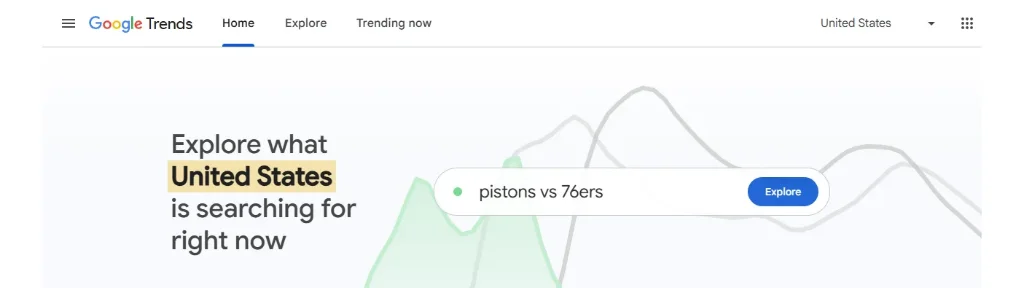
Google Trends is Google’s own free, publicly accessible window into search behavior across its 4B+ user base — covering trending topics in real time, historical search interest going back to 2004, geographic breakdowns down to city level, and comparisons across up to five topics simultaneously.
It powers the Year in Search annual cultural report, real-time election tracking, dedicated Frightgeist Halloween costume trend analysis, and the OECD Weekly GDP Tracker — and it is the underlying data source that Glimpse, Treendly, and Exploding Topics are all built on top of. Used daily by newsrooms including the New York Times, BBC, and Reuters.
2. Sources & Data Coverage
Google’s own search data — the single largest consumer intent dataset on the planet, drawn from billions of daily searches across Web, Image, News, Google Shopping, and YouTube Search, all segmentable by search type.
Every signal is real, aggregated, and anonymized directly from what people type into Google, making it the most truthful consumer behavior data available anywhere.
No editorial filter, no algorithm layer, no third-party proxy — just raw search interest from the world’s most-used information source.
3. How Trends Are Surfaced
Three modes in one tool: Explore (type any keyword, compare up to 5 terms, filter by country, time range, category, and search type — output is a 0–100 relative interest index with related topics and related queries attached), Trending Now (real-time trending searches globally or by country, updated hourly with search volume estimates and linked news articles), and curated Dive Deeper experiences (Year in Search, election trackers, Frightgeist, and special data visualization projects).
The Related Queries section is where Google Trends genuinely earns its place as a trend discovery tool — it surfaces what people are searching alongside your keyword, revealing adjacent topics no keyword tool generates as accurately.
4. Pricing Model
Completely free — no account required for most features, no credit card, no tier limits, no usage caps, no paid plan.
Google Trends has been free since its launch in 2006 and has no monetization layer. An unofficial API (via the open-source pytrends Python library) is accessible for developers wanting to automate data pulls, though it is rate-limited and unsupported officially.
The only “cost” is the 0–100 relative scale output — it deliberately does not show absolute search volume figures, which is where Glimpse and Treendly step in as paid layers on top.
5. Limitation / Verdict
The relative data limitation is Google Trends’ single most significant constraint — and it’s deliberate. The 0–100 scale shows directional interest and comparative strength, but not actual search volume numbers.
This means you can see that “GLP-1 supplement” is growing fast, but not that it has 74,000 monthly searches — you need Glimpse or a keyword tool for that.
There’s no automated trend monitoring or alert system for search trends (only Google Alerts for news mentions), no cross-platform social signals, no trend forecasting, no curated discovery of topics you haven’t thought to search, and no user dashboard for tracking a portfolio of keywords over time. For all of those workflows, every other tool on this list adds meaningful value on top.
⭐⭐⭐⭐½ — The most important free tool in any content creator or marketer’s research stack — not because it does the most, but because everything else is built on top of it. Start here before paying for anything else; use the other tools on this list when you need what Google Trends deliberately doesn’t give you.
Answer Socrates
Quick note: Answer Socrates is primarily an SEO keyword research and content strategy platform — the Trending Topics tool at answersocrates.com/trends is one specific free tool within a broader suite. It’s positioned here for its unique combination of trend discovery and question intelligence, which no other tool on this list matches in the same workflow.
Best for bloggers, content marketers, and YouTubers who want to know not just what’s trending — but the exact questions people are asking about those trends right now, so they can create content that captures the moment before anyone else.

1. What it specializes in
Answer Socrates’ Trending Topics Tool surfaces fast-rising topics by country alongside TikTok trending searches — then, uniquely, drills into each trend to reveal 500+ questions real people are typing around that topic, so you move from “what’s trending” to “what should I write” in a single workflow.
Free to use with no credit card, and part of a broader SEO platform that also includes keyword clustering, LLM brand tracking, AI article writing, and MCP access.
2. Sources & Data Coverage
Two distinct data streams in one view: Google trending searches (organized as questions by topic and country) and TikTok trending topics — refreshed daily.
Select any country and the tool adapts to surface locally relevant trends, covering English-speaking markets and international locales including Spanish, German, and French-language audiences.
The question layer underneath each trend is sourced from real search queries — what people type into Google around a trending topic, surfaced in 500+ question clusters per trend.
3. How Trends Are Surfaced
A four-step workflow: select country → view rising topics grouped by question clusters → click any topic to expand 500+ related questions people are asking right now → export to CSV or Google Sheets and share a link directly with your team.
The grouping by question cluster is the standout differentiator — instead of a flat list of trending keywords, you get themed question buckets (how, what, why, where, when) that map directly to content angles, video titles, and blog post structures.
The TikTok trending section runs in parallel, letting you cross-reference what’s rising on search with what’s gaining momentum on short-form video simultaneously.
4. Pricing Model
The Trending Topics tool is completely free — no account required to use it. The broader Answer Socrates platform offers a free tier (3 keyword searches/day, 1 CSV download/month) and four paid plans: Socrates Lite at $19/month ($15.83/month annually) — SEO metrics, unlimited CSV downloads, 2 projects; Seneca at $39/month ($32.50/month annually) — API and MCP access, 5 projects; Aurelius at $69/month ($57.50/month annually) — unlimited keyword searches, 2 team seats; Senate at $299/month ($249.17/month annually) — full agency team features, 100 projects, 36,000 LLM Brand Tracker credits. A 7-day money-back guarantee applies to all paid plans; cancel anytime with no phone call required.
5. Limitation / Verdict
Answer Socrates’ Trending Topics tool is a content ideation engine — not a deep trend intelligence platform.
It doesn’t show historical growth trajectories, search volume data (without a paid plan), trend forecasting, monitoring alerts, or multi-year trend curves like Exploding Topics or Glimpse.
It’s also a daily-refresh tool, not real-time within the hour like Google Trends’ Trending Now section.
The trend data is a starting point for the question research layer rather than the primary deliverable — if in-depth trend analysis is your need, the other tools on this list serve that better.
What it does better than anything else: collapsing the gap between “I see something is trending” and “here are 500 questions I can write content around right now.”
⭐⭐⭐⭐ — The most content-creation-ready free trend tool on this list. The moment you click a trending topic and see 500 questions people are actually asking about it, the use case clicks immediately.
An essential free companion to Google Trends for any blogger, content marketer, or YouTube creator who turns trends into traffic.
Exploding Topics
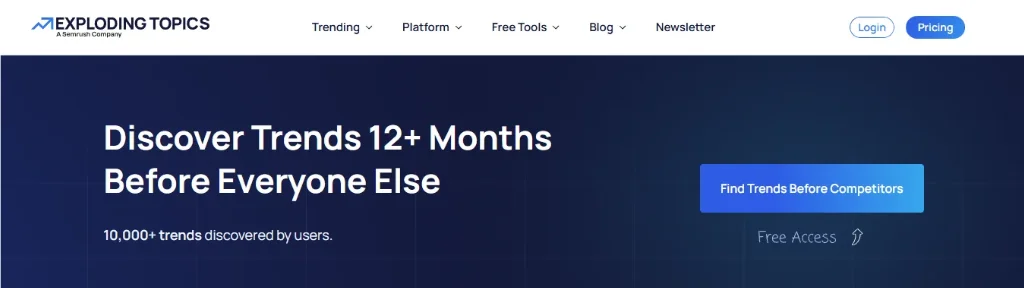
Best for content creators, SEO strategists, ecommerce founders, and investors who want to find topics, products, and markets 12+ months before they go mainstream — with verified results like pickleball, mushroom coffee, Substack, and Perplexity all spotted years early.
1. What it specializes in
Exploding Topics discovers under-the-radar trends — topics, products, startups, and markets — before they hit mainstream awareness, by tracking consumer behavior signals across social media, search engines, forums, news, ecommerce, and podcasts simultaneously.
A Semrush company with 1.1M+ users and a 1.1M+ trend database, trusted by Google, McKinsey, Goldman Sachs, Unilever, Shopify, Deloitte, and Penguin Random House — spanning solutions for ecommerce, marketing agencies, investors, and market researchers.
2. Sources & Data Coverage
Multi-platform signal aggregation across social media, search engines, online communities, news, ecommerce sites, and podcasts — processed by a proprietary ML algorithm that detects the earliest statistical signs of growth, then manually reviewed and curated by a human team.
The curation step is what separates Exploding Topics from raw search trend tools: the team actively filters out fads (movies, TV shows, celebrity gossip) to surface only durable, growing topics with real commercial potential.
3. How Trends Are Surfaced
Browse 1.1M+ topics by category — AI, Technology, Fitness, Marketing, Media, and many more — each with growth percentage and search volume data plotted over time.
Meta Trends reveal big-picture market shifts across tech, DTC, SaaS, healthcare, fitness, and fashion — one layer above individual topics.
Trend Forecasting (Investor and Business plans) uses ML to project where a trend will be next year.
Trending Startups surfaces companies with early exponential growth signals — used by VCs to identify investment opportunities before others.
A TikTok Insights add-on specifically surfaces trends gaining momentum on TikTok before they spill into search.
4. Pricing Model
Free access via the homepage trend explorer and 8+ free tools (keyword research, SEO checker, competitor analysis, AI visibility checker, and more) — no account required.
Pro plans: Entrepreneur at $39/month (100 tracked trends, 10 trend analyses, full database, meta trends, channel breakdown), Investor at $99/month (500 tracked trends, 100 analyses, trending startups, trend forecasting, CSV export), Business at $249/month (2,000 tracked trends, 500 analyses, trend reports).
All plans include a 7-day free trial. No free-forever tier beyond the public trend explorer and free tools.
5. Limitation / Verdict
Exploding Topics is not a real-time social trend tool — it won’t show you what’s trending on X at 9am this morning.
Its strength is early-stage discovery weeks, months, or years before mainstream awareness, which means it’s the wrong tool for reactive, news-cycle content but the right one for strategic content planning, product validation, and market research.
Tracked trend and analysis quotas are tight on the Entrepreneur plan (10 analyses/month), and the TikTok Insights add-on costs extra on top of the base subscription. The monthly-only pricing structure also means no annual discount to reduce costs for long-term subscribers.
⭐⭐⭐⭐½ — The most broadly useful and best-proven trending topics platform on this list for anyone building content or products around what’s about to become important — not what already is.
Its track record of spotting pickleball, mushroom coffee, Substack, Perplexity, and air fryers years before they peaked is the most compelling product proof point in this entire roundup.
Glimpse
Best for SEO strategists, content marketers, and ecommerce founders who live in Google Trends and want to unlock what it’s always been missing — absolute search volume, channel breakdowns, forecasting, and multi-platform trend signals — without switching to a new platform.
1. What it specializes in
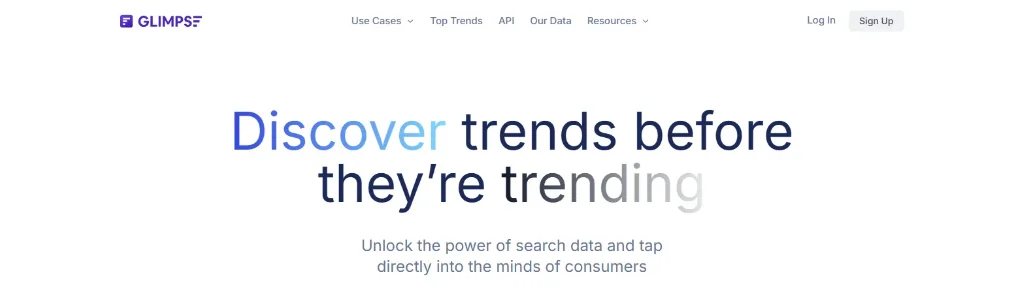
Glimpse is a Google Trends supercharger — a Chrome extension that layers real search volume, growth metrics, channel breakdowns, and trend forecasting directly onto the Google Trends interface, while also operating as a standalone trend discovery platform.
Trusted by Google, Amazon, Unilever, a16z, the New York Times, Coca-Cola, HarperCollins, Shopify, Adobe, and Chanel — across 132+ countries — with 200,000+ Chrome extension users and a 4.91 star rating in the Chrome Web Store. Its claim: 120x more trends than the closest competitor.
2. Sources & Data Coverage
Hundreds of millions of consumer behavior signals aggregated from across the web — with search data as the primary layer (the most valuable signal: 4B+ global users sharing more with search engines than anywhere else online).
Channel breakdown maps every tracked topic across TikTok, LinkedIn, Reddit, Instagram, Twitter, YouTube, Facebook, and Pinterest simultaneously — showing where consumers are talking about a given trend and at what volume.
People Also Search data surfaces the adjacent topics consumers explore alongside your keyword, revealing related opportunities most competitors miss entirely.
3. How Trends Are Surfaced
Glimpse surfaces trends through three modes: active research (type any keyword, get absolute search volume, YoY and MoM growth, channel breakdown, forecasting, and seasonality-adjusted trajectory in one view), passive discovery (bi-weekly exponential trend reports and real-time alerts when tracked keywords spike or drop), and browsing (curated trend categories across Beauty, Food & Beverage, Health & Wellness, Technology, Finance, Fashion, Gaming, and dozens more — all updated daily).
Trend Forecasting uses ML trained on millions of data points with 95%+ backtested accuracy to show what next year’s trajectory will look like. Its prediction track record includes Perplexity AI (3.8 years early), and Pickleball, TikTok, Substack, Canva, Mouth Tape, and Pimple Patches — all spotted 4+ years before they peaked.
4. Pricing Model
No pricing page exists on meetglimpse.com — a deliberate choice that multiple reviewers find frustrating, and worth knowing if you expect pricing transparency before signing up.
Pricing: Hobbyist at $0/month (10 trend lookups/month, Chrome extension, one bi-weekly trend report), Pro at $99/month (~250 lookups, full search volume, forecasting, keyword tracking, trend alerts), Expert at $299/month (unlimited lookups, broader keyword tracking), Enterprise at custom pricing (API access, team seats, higher limits). Annual billing saves 2 months on paid plans. No credit card required for the free tier.
5. Limitation / Verdict
The hidden pricing model is the platform’s biggest UX friction point — no pricing page, no published figures, and pricing is only discoverable after signup or through third-party reviews like this one.
The 10-lookup free tier is too limited for any meaningful research, and $99/month for 250 lookups is a harder sell for casual users than Exploding Topics’ $39/month Entrepreneur plan.
Glimpse is also primarily search-data driven — social-only trends that never surface in Google Search may be underweighted relative to their true cultural momentum.
The Chrome extension dependency also means the full experience requires Chrome, not a dealbreaker but worth noting.
⭐⭐⭐⭐½ — The most practical daily-use trend tool for anyone already in Google Trends regularly. Where Exploding Topics is a destination platform you visit to discover trends, Glimpse is the upgrade layer that turns the tool you’re already using into a professional-grade intelligence engine.
The absolute volume data and channel breakdown alone justify the subscription for SEO strategists and ecommerce teams who make keyword decisions daily.
Treendly
Best for solo creators, indie makers, students, and budget-conscious marketers who want to discover rising trends before they go mainstream — at the most affordable price of any professional tool on this list, with API and MCP access included.
1. What it specializes in
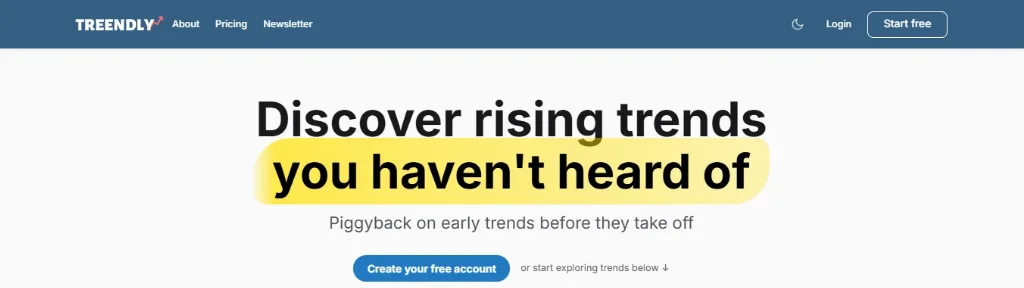
Treendly is a curated trend discovery platform for finding rising topics, companies, and products before they go mainstream — built specifically for people who want to find things they haven’t heard of, not just research things they already know.
Trusted by 44,697 users across 6 languages, covering 16 trend categories from Beauty, Food and Health to Software, Finance, and Automotive — with filtering by growth rate, popularity, volatility, and forecast trajectory.
The platform’s own description says it best: “Google Trends is for researching things you’ve heard of. Treendly is for finding things you haven’t.”
2. Sources & Data Coverage
Treendly aggregates search and consumer behavior data into three distinct trend types — Concepts, Companies, and Products — with absolute monthly search volume attached to each (e.g. Galaxy Ring at 301K/month, GLP-1 at 550K/month, Zone 2 Cardio growing rapidly).
Country-specific trends are available in 19 countries on the Pro plan — including the US, UK, India, Germany, Australia, Brazil, Japan, and South Korea — with worldwide trends accessible on the free tier.
Popularity is bucketed clearly: Very High (100K+), High (20K–100K), Medium (5K–20K), Low (1K–5K), and Very Low (0–1K) — making it easy to filter for early-stage opportunities before volume spikes.
3. How Trends Are Surfaced
Three discovery modes: browse curated trend categories filtered by growth rate (Rapid, Sustained, or Decline), volatility (Low, Average, High), and forecast (Growth, Flat, Decline); search any keyword directly; or set up trend monitoring to receive alerts when specific tracked topics move.
An “Early” filter (Pro only) surfaces the earliest-stage rising trends before they show up in volume-based searches — the most useful filter for getting ahead of competitors.
A premium newsletter delivers curated rising trends directly to your inbox. Chrome extension, Notion integration, and WordPress integration mean trends surface inside the tools you already use rather than requiring a separate platform visit.
4. Pricing Model
Free forever: $0, no credit card required — unlimited trend search, monitor up to 3 trends, regular newsletter, limited curated trend library, 1 user seat.
Pro: $99/year ($8.25/month effectively, shown as $8/month billed annually) — 14-day free trial, monitor up to 25 trends, premium newsletter, full curated trend library, 19-country filters, Early filter, volatility and forecast filters, API and MCP access, 4 user seats, custom reports. Enterprise: price on application — unlimited trend monitoring, 10+ user seats, full API and MCP access.
The grandfathering promise is worth noting: early adopters are locked at the current price for life as features expand and pricing increases — a meaningful incentive to join now.
5. Limitation / Verdict
The free plan’s 3-trend monitoring limit is tight for any active research workflow, and Pro’s 25-trend cap — while affordable — trails Exploding Topics significantly (100 on Entrepreneur, 2,000 on Business).
At 44,697 users, Treendly is a considerably smaller community than Exploding Topics (1.1M+) or Glimpse (200K Chrome users), which means less social proof and a smaller feedback loop shaping the platform’s curation quality.
As a solo-founder product (built by Mike Rubini), enterprise support expectations should be set accordingly — though 24/5 live chat is included.
The platform is also less established in terms of independently verified early-trend track record compared to Exploding Topics’ documented history of spotting Perplexity, pickleball, and mushroom coffee.
⭐⭐⭐⭐ — The most affordable professional-grade trend discovery tool on this list, full stop. At $99/year with API and MCP access, 19-country filtering, and a genuinely useful Early filter, Treendly delivers remarkable value for any creator, student, or indie maker who wants a trend edge without paying $39–$99/month for it. The grandfathering promise makes signing up now an easy decision.
My Recommendation
There’s no single best tool here — the right one depends entirely on what you’re creating, where you publish, and how far ahead you want to see.
For content creators who want to turn trends into ready-to-write content instantly, Answer Socrates bridges the gap between discovery and execution faster than any tool on this list.
For the earliest possible signal on emerging markets before they peak, Exploding Topics has the most verified track record.
For daily Google Trends intelligence with absolute volume and channel breakdowns, Glimpse is the natural upgrade layer.
For budget-conscious creators who want serious trend discovery at $8/month, Treendly is the strongest value play.
And for everything else — the baseline that all of these tools are built on top of — Google Trends remains the most important free tool in any researcher’s stack.
One final principle: the best tool to find trending topics is the one you’ll actually open every day. Start free, pick the tool that fits your workflow, and make trend research a habit — not a last-minute scramble.
Note:
The pricing information for these platforms may be subject to change over time. Therefore, we recommend checking their respective websites for the most up-to-date and accurate information regarding pricing.
- Also note that the information may have changed since the publication.
70+ Best Twitter Tools (Ultimate List for Influencers)
F.A.Qs About Tools to Find Trending Topics Online
How to find trending topics?
Use the tools listed above to find trending topics.