It is estimated that the eLearning market size will be worth $1 Tn by 2028 as the demand and acceptance of online courses are growing day by day.
Your expertise is worth more than a LinkedIn post. The right online course platform turns what you know into a product that sells while you sleep — no studio, no publisher, no middleman required.
But picking the wrong one is expensive. Some platforms quietly take 10% of every sale. Others lock your best features behind enterprise pricing.
A few look great until you actually try to build something, and suddenly you need three other tools just to send an email.
We’ve reviewed the best creator-first online course platforms — from community-led spaces like Skool to full business stacks like EzyCourse — so you can launch, grow, and monetize without the platform becoming the problem.
Disclosure: This post may contain affiliate links. This means if you click on one of the links and purchase anything I may receive some affiliate commission at no extra cost to you. Thanks in advance for your support.
Best Online Course Platforms
FreshLearn
Best for creators, coaches, and growing academies who want the broadest feature set at the lowest price — with zero transaction fees, 24/7 human support, and an AI Studio that makes learners actually learn instead of just watch.
1. What it specializes in
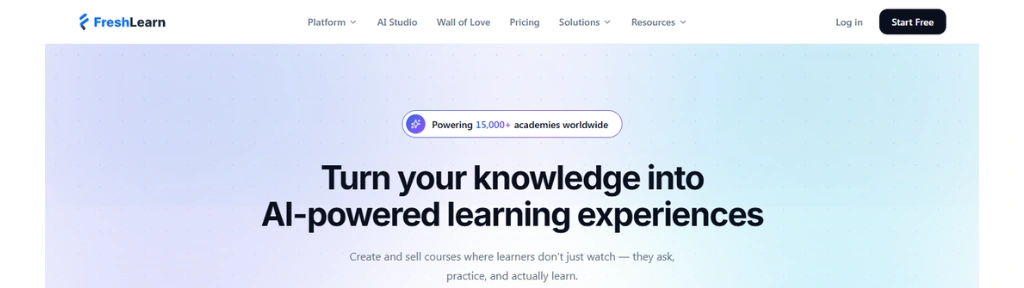
FreshLearn helps you create unlimited courses, engage your audience, and grow your income — all with zero transaction fees and full control over your brand.
Trusted by 15,000+ academies across 80+ countries, with $240M+ earned by creators on the platform — spanning individual creators, CE providers, branded academies, and enterprise training teams from a single platform.
2. Course Building & Student Experience
A drag-and-drop course builder covering self-paced courses, live cohorts, masterclasses, digital downloads, product bundles, and community — all in one place.
The standout is AI Studio: Course AI lets learners ask questions and get instant, context-precise answers sourced directly from your video content; AI Coach lets learners practice real scenarios (sales calls, interviews) with an AI that responds, challenges, and scores them; AI Quiz Generator auto-generates assessments from lesson content.
Auto-captions, gamification, video compliance controls, drip content, and certificates round out one of the richest student experience stacks at this price point.
3. Marketing & Monetization Tools
Zero transaction fees on all paid plans — you keep 100% of your revenue minus standard Stripe/PayPal processor fees, compared to Teachable’s 5–10% on lower tiers.
Built-in email campaigns with drip sequences, a blogging CMS, landing pages, sales funnels, affiliate and referral programs, coupons, advanced checkout customizations, and automations — replacing a stack that typically costs $639/month across separate tools for as little as $79/month on FreshLearn.
4. Pricing Model
Free: $0 — 1 product, 25 manual enrollments, 3 sales pages, no credit card required. Pro: $35/month (bi-annual) — courses, masterclasses, digital downloads, AI website builder, email campaigns, custom domain, 1 admin.
No Brainer: $49/month (bi-annual) — adds community, live classes, certificates, gamification, AI quiz generator, auto-captions, referral program, branding removal, Zapier, learner mobile app, 3 admins, free migration.
No Brainer+: $99/month (bi-annual) — adds Course AI, unlimited automations, API access, native integrations (Zoom, HubSpot, Mailchimp), advanced assessments, user roles, and a customer success manager. A 14-day money-back guarantee is included on all yearly plans.
5. Limitation / Verdict
1:1 Coaching is listed as “coming soon” on No Brainer+ — a gap for coaches wanting that feature now. SCORM and xAPI are Enterprise-only, meaning corporate L&D teams with compliance requirements will need to upgrade.
The branded mobile app is a paid add-on at $199/year per platform (iOS or Android separately), and community features don’t unlock until the No Brainer plan.
The free plan’s 25-enrollment cap is also too restrictive for any real launch. That said, the 24/7 human support with a sub-2-minute average response time — not a chatbot — is a genuinely rare and consistently praised differentiator.
⭐⭐⭐⭐½ — The most complete all-in-one creator platform at this price range, with the most creator-friendly transaction fee policy on this entire list. A compelling Kajabi or Teachable alternative for anyone scaling a real learning business without wanting to pay platform tax on every sale.
LearnWorlds
Best for creators, coaches, and training providers who want the most interactive student experience on the market — with AI that builds the course for you and interactive video that turns passive watching into active learning.
1. What it specializes in
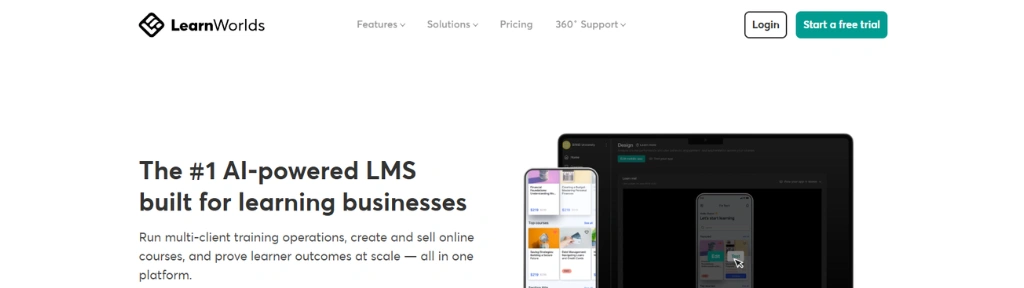
LearnWorlds is a complete LMS software to build, deliver, and scale training programs — trusted by 13,000+ learning businesses including Honda, Adidas, Kaspersky, UNICEF, Wagamama, and Workable.
Founded by PhDs with 20+ years of instructional design experience, it’s built on the science of how people actually learn, spanning creators, coaches, fitness professionals, healthcare educators, B2B training providers, and NGOs under one platform.
2. Course Building & Student Experience
LearnWorlds AI builds courses, assessments, email sequences, and images from scratch — generate a complete course outline and quiz set in minutes.
The student experience is genuinely best-in-class: interactive video automatically extracts transcripts, embeds quizzes at any timestamp, and generates a clickable table of contents from any uploaded video — turning passive watching into active, measurable learning.
Add live sessions via Zoom, Google Meet, Teams, or Webex, a built-in community and social network on every plan, drip content, certificates, and SCORM compliance on Pro Trainer and above, and LearnWorlds has the deepest student experience stack on this list.
3. Marketing & Monetization Tools
Sales pages, page funnels with AI, coupons, order bumps, upsells, tiered subscriptions, installment payments, bundles, and affiliate marketing are all built in — with 50+ native integrations including HubSpot, Stripe, Shopify, Mailchimp, and Zapier.
The unique Course Hub feature lets you license your courses to other organizations for B2B revenue — a monetization path no other creator-first platform on this list offers.
4. Pricing Model
Starter: $24/month (billed annually) with a $5 flat fee per paid enrollment — 1,000 active learners/month, 1 admin, 300 AI credits. Pro Trainer: $79/month (annually), no enrollment fees, 2,000 learners, 5 admins, 500 AI credits, certificates, SCORM, Zapier.
Learning Center: $249/month (annually), no enrollment fees, full white-label, 25 admins, 10 client groups, automation engine, and scheduled reports. Corporate: custom pricing. A 30-day free trial is included on all plans. Note the $5 per enrollment fee on Starter — it disappears entirely at Pro Trainer, which is a meaningful upgrade trigger.
5. Limitation / Verdict
The Starter plan’s $5-per-enrollment fee can silently eat into early revenue before you realise you need to upgrade — worth calculating against your expected sales volume before committing.
Active learner caps (1,000 on Starter, 2,000 on Pro and Learning Center) may also require a Corporate conversation sooner than expected for fast-growing schools.
The branded mobile app is an add-on on every plan, not included. White-label branding is locked to the $249/month Learning Center tier — a significant price jump if that’s a deal-breaker earlier.
⭐⭐⭐⭐½ — The most instructionally sophisticated creator platform on this list, with an AI course builder, interactive video engine, and student experience depth that no competitor matches at this price range. The platform that serious learning businesses grow into, not out of.
ezycourse
Best for growing creators and online business owners who want the most feature-dense all-in-one platform on the market — with a branded mobile app included free, zero transaction fees, and native live meetings without needing Zoom.
1. What it specializes in
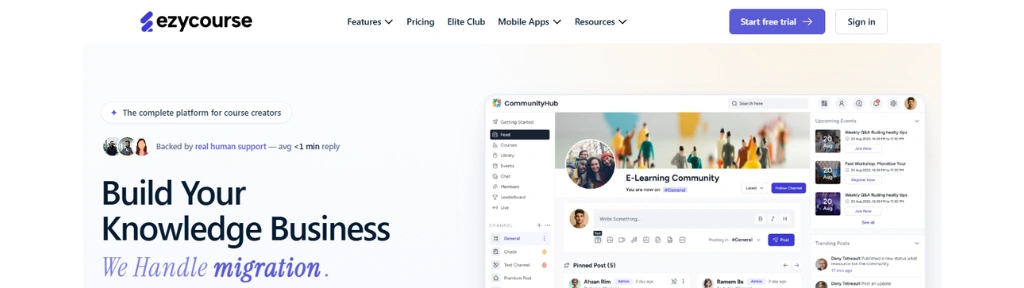
EzyCourse is the complete platform for course creators — create, market, sell, and deliver all in one place, backed by real human support with an average sub-1-minute reply time.
Rated 4.8/5 on G2, Capterra, AppSumo, and Trustpilot across 12 G2 categories, with $1M+/year earned by top creators — covering courses, communities, coaching, memberships, digital products, events, appointments, branded mobile apps, email marketing, and automation in a single subscription.
2. Course Building & Student Experience
A drag-and-drop AI course builder with unlimited courses, SCORM support, drip content, autoplay, assignments, certificates, and an advanced quiz engine — with randomised question banks, time limits, and granular retake controls.
The community layer is unusually rich: Facebook-like feeds with topic channels, group chats, private messaging, gamification, leaderboards, and a coins system. On the Unlimited plan and above, native meetings for up to 300 attendees are built directly into the platform — no Zoom required.
3. Marketing & Monetization Tools
0% transaction fees across every single plan — you keep 100% of your revenue. A complete marketing stack is included: AI website builder, email campaigns (10K–500K/month depending on plan), unlimited automation workflows, landing pages, multi-level affiliate program, revenue partner collaboration with automatic revenue splits, smart upsell, order bumps, magic 1-click checkout, cart checkout, B2B seat management, and multi-currency support.
The Elite plan adds AI and LLM optimization so your content can be discovered through ChatGPT, Claude, Gemini, and Perplexity — one of the first course platforms to surface AI search as a native marketing feature.
4. Pricing Model
Essential: $59/month (annual) — unlimited courses, 2 communities, 1 coaching program, 10,000 emails/month, 1TB video storage. Pro: $139/month (annual) — 5 communities, 5 coaching programs, unlimited events, affiliate program, 50,000 emails/month, 3TB storage, complete website design service included free.
Unlimited: $199/month (annual) — unlimited communities and coaching, branded iOS and Android apps included free, native meetings for 300 attendees, DRM video protection, PDF stamping, 100,000 emails/month, 5TB storage.
Elite: $299/month (annual) — every current and future add-on included, Android TV app, 500,000 emails/month, 10TB storage, VIP support. A 14-day free trial and a 30-day money-back guarantee are included on all plans. No credit card required to start.
5. Limitation / Verdict
The Essential plan’s limits feel tight for anyone with real ambitions — 2 communities, 1 coaching program, 20 active coaching clients, 1 automation workflow, and single-currency support all push active creators toward the Pro tier fairly quickly.
Native meetings are an add-on on Essential and Pro — unlocking only at the $199/month Unlimited plan.
There’s also no free-forever plan, only the trial. And while EzyCourse is growing fast with an active 3,200+ member community and strong G2 momentum, it’s still a younger platform than Kajabi or Teachable, and some creators value that incumbency track record for long-term stability.
⭐⭐⭐⭐½ — The most feature-dense creator platform per dollar on this list, with the branded mobile app inclusion on Unlimited alone saving $2,388–$30,000+/year compared to every major competitor.
If you’re running a serious knowledge business and want one platform that genuinely replaces your entire stack without paying transaction tax on every sale, EzyCourse deserves a serious look.
Pinlearn
Quick heads-up: Pinlearn is a fundamentally different type of product from the other platforms on this list. It’s not a SaaS tool for individual creators selling their own courses — it’s a self-hosted tutoring marketplace script for entrepreneurs who want to build a multi-tutor platform like Preply, Verbling, Udemy, or Cambly. Worth reading carefully before comparing it against LearnWorlds or FreshLearn.
Best for entrepreneurs and edtech startups who want to build and own their own online tutoring marketplace — with full source code, zero recurring fees, and no dependency on any SaaS vendor.
1. What it specializes in
Pinlearn is a self-hosted online tutoring marketplace software that lets you build your own tutoring platform like Verbling, Preply, or Cambly — white-label, customizable, with integrated live class tools.
Instead of one creator selling to students, Pinlearn is built for the marketplace model: you run the platform, tutors sign up to teach, and you earn a commission on every course sold or session booked — exactly how Udemy or Preply operates.
2. Course Building & Student Experience
Tutors can create, upload, and sell self-paced courses, conduct 1-on-1 live classes via video conferencing using an integrated interactive whiteboard, and schedule group webinar classes with entry fees and participant limits — all managed from a dedicated tutor dashboard.
Students browse tutor profiles, filter by subject, book appointments, and message tutors directly through a built-in internal messaging system.
3. Marketing & Monetization Tools
Multiple revenue channels, commission management, coupons, gift a course or webinar, SEO-optimized pages, reviews and ratings, and advanced search filters are included in the base product.
The admin controls commission percentages taken from tutor sales, creating a marketplace revenue model rather than the flat-fee creator model. There’s no built-in email marketing or automation stack — marketing is handled externally or through add-ons.
4. Pricing Model
Both plans are one-time fees with no recurring monthly or annual charges and zero transaction fees. Starter: $699 — includes encrypted source files, free installation and setup, 1-year support and updates, onboarding call, and full IP rights.
Professionals: $1,499 — everything in Starter plus 100% unencrypted, fully customizable source code. The critical difference between plans: the Starter plan runs as-is with no code access, while the Professionals plan gives you full developer-level control to modify or extend anything. Add-ons for features beyond the base product are available separately.
5. Limitation / Verdict
Pinlearn is entirely the wrong fit for an individual creator who wants to sell their own courses — it’s a marketplace builder, not a creator tool. The Starter plan’s encrypted source code means you’re locked into the base feature set unless you pay for add-ons or upgrade.
Only 1 year of support and updates is included in both plans — ongoing updates require renewal. There’s no built-in email marketing, sales funnel builder, or affiliate program in the traditional creator platform sense, and mobile app support is a separate add-on rather than a core inclusion.
Setup also requires self-hosting, domain configuration, and some technical comfort — though free installation support is included.
⭐⭐⭐⭐ (for marketplace builders only) — If your goal is to launch your own Preply or Udemy rather than sell your own expertise, Pinlearn offers the most cost-efficient and ownership-first path to that outcome — paying once instead of hundreds per month on SaaS indefinitely. The wrong tool for individual creators; the right tool for edtech marketplace entrepreneurs.
Simplero
Best for coaches and founder-led service businesses who want a platform built specifically around coaching — not repurposed course software — with deep automation, a genuine community ethos, and one of the most loyal support cultures in the space.
1. What it specializes in
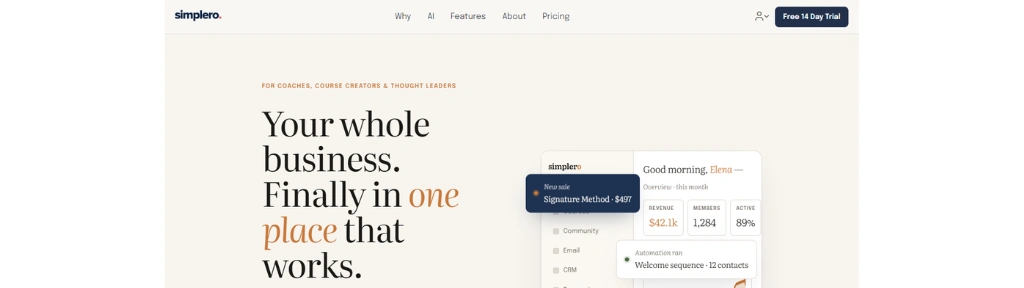
Simplero is an all-in-one creator platform to replace all your other tools for courses, coaching, community, email, and payments — so you can coach more and tech-stress less.
Founded in 2008 by Calvin Correli, a coach-turned-developer, it’s one of the oldest platforms in this space and has facilitated $841M+ in creator sales across 6.2M+ transactions.
Distinctly coaching-first rather than course-first — the positioning, feature set, and community all reflect a platform built by a coach for coaches.
2. Course Building & Student Experience
Courses, memberships, and community sit alongside a full coaching stack — scheduling, client portals, 1:1 programs, and group coaching journeys — all delivered through a branded mobile app that goes with your clients wherever they go.
The client portal gives learners unified access to content, community, and coaching in one place, rather than the fragmented experience of stitching together separate tools.
Deep automation lets you build sophisticated client journeys — email sequences triggered by enrollment status, payment behavior, lesson completion, and more — with deeper automation and customization options than Kajabi and other course platforms.
3. Marketing & Monetization Tools
A full suite is built in: website builder, funnels, email campaigns and CRM, payments via Stripe and PayPal, coupons, affiliate commissions ($8.4M+ paid out to date), and scheduling — all integrated so client data flows between every tool without manual syncing. 0% transaction fees across plans.
Third-party integrations cover Zapier, Mailchimp, and WebinarJam for teams already invested in an existing stack.
4. Pricing Model
Three plans, all with a 17% annual discount and a 14-day free trial. Starter: $70.80/month (monthly) or ~$59/month (annually) — 5 products and courses, 1 membership site, 1 custom domain, 1 admin, 250GB storage, 500 base contacts.
Scale: $178.80/month (monthly) — unlimited products, courses, and sites, advanced automations, multiple custom domains, scheduling users. Skyrocket: $298.80/month (monthly) — adds unlimited storage, AI Bot credits, unlimited scheduling users, advanced payment features, and custom admin roles.
A significant caveat: on the Starter plan, contacts beyond 500 are billed separately as add-ons ($10/month per 1,000 extra), which can make costs escalate faster than the headline price suggests if your list is growing.
5. Limitation / Verdict
The Starter plan’s 5-product cap and 500-contact base limit are notably restrictive compared to competitors like FreshLearn or EzyCourse at similar price points — and the contact add-on model can quietly inflate your bill.
With only 22 reviews on Capterra versus thousands for LearnWorlds or Teachable, the platform’s community is tight-knit but its third-party track record is harder to evaluate. Integration depth is also narrower than some competitors.
That said, Simplero’s 16+ years of operation, the founder’s active community presence, and its consistently praised human support set it apart from the venture-backed platforms that prioritize features over relationships.
⭐⭐⭐⭐ — Not the most feature-dense or price-efficient option on this list, but arguably the most human-centred one. If coaching is your identity rather than just your business model, Simplero’s culture may be worth the premium over a cheaper, less soul-ful alternative.
Graphy
Quick heads-up: Graphy has gone through significant changes. It’s the result of Unacademy’s original Graphy platform merging with Spayee — an Indian LMS it acquired for $25M in 2021 — which was officially rebranded as Graphy in March 2025. The unified product is relatively young (~16 months old as of mid-2026), and older third-party reviews describe legacy Spayee or legacy Graphy models that no longer reflect current pricing or features. Worth flagging so you can evaluate the platform as it is now, not what it was.
Best for creators who want to start with zero upfront cost — paying only a flat platform fee until their revenue justifies upgrading — or for established creators who need white-labeled mobile apps and DRM protection at a lower price than Kajabi.

1. What it specializes in
Graphy is an all-in-one platform designed to help creators, educators, and business coaches sell online courses, launch white-labeled teaching websites or mobile applications, host webinars, and offer memberships — with live streaming, community tools, email marketing, and built-in monetization across a free-to-join and paid subscription structure.
2. Course Building & Student Experience
Creators can build courses with audio, video, PDFs, SCORM, assignments, and forms, alongside quizzes, certificates, discussion forums, and student performance tracking — with live classes, group webinars, and a community layer featuring chat groups, threads, and reactions.
A customizable landing page builder with a drag-and-drop interface and predefined templates sits alongside in-depth analytics and daily reports for tracking what’s working.
3. Marketing & Monetization Tools
A no-subscription free tier charges a flat 5% platform fee per transaction — the lowest barrier to entry of any platform on this list.
Paid plans drop this to 0%. Accept payments via UPI, cards, and EMI — a meaningful differentiator for South Asian creator markets — alongside multiple international payment gateways.
Built-in email marketing, automations, landing pages, and a $14M creator-grant program called Graphy Select round out an unusually rich monetization support ecosystem for a platform at this price point.
4. Pricing Model
Three paid tiers — Launch at $49/month ($37/month annually), Rise at $149/month ($112/month annually, marked Recommended), and Scale at $399/month ($299/month annually) — all with 0% platform transaction fees.
A 14-day free trial requires no credit card, plus a 7-day refund window after paid signup. The critical detail: native iOS and Android apps are Rise-and-above features only, starting at $112/month annually — the entry Launch plan has no mobile app at all, making the real Kajabi comparison a $112 Rise plan versus Kajabi’s Basic at $143 annually, not the headline $49 Launch price.
Marketing email overages cost $0.002 per email beyond the plan cap; overage behavior for live class minutes and webinar participant limits is not publicly documented — ask Graphy directly before committing.
5. Limitation / Verdict
Support quality is a genuine concern — some reviewers report onboarding delays of 7–10 months and difficult post-payment support, which is a significant red flag for any creator planning a time-sensitive launch.
The branded mobile app on Rise and Scale is not a managed service — you build it, unlike EzyCourse which submits fully managed apps to the stores for you. The platform’s unified form is also only ~16 months old, which means some rough edges from the merger are still being smoothed out.
That said, for Indian and South Asian creators specifically, the UPI payment support, SCORM compliance, and DRM video protection at this price range are genuinely hard to match.
⭐⭐⭐½ — A platform with real potential, especially for the South Asian market, but one where the onboarding experience and support consistency need careful evaluation before committing your business to it.
Skool
Quick heads-up: Skool is a community-first platform with courses bolted on — not a course-first platform with community features added. This distinction matters enormously when comparing it to the other tools on this list. If live engagement and community retention are your core product, Skool is a front-runner. If structured course delivery and completion tracking are your core product, look elsewhere.
Best for coaches, cohort builders, and creators whose business is built around ongoing community engagement — where the conversations and relationships are the product, not just the delivery vehicle.

1. What it specializes in
Skool is a community platform that combines discussions, courses, live sessions, and simple engagement tools in one space — built by Sam Ovens and backed by Alex Hormozi, with a deliberate philosophy of doing fewer things better rather than competing on feature breadth.
It focuses on connection and participation rather than complex course design — a distinction that has resonated strongly with coaches, membership builders, and cohort-based creators.
2. Course Building & Student Experience
Skool includes a built-in Classroom where you can host unlimited courses with video, text, and file content — and in 2026 added “Buy Now” standalone courses and one-time purchase options alongside subscriptions.
The student experience is deliberately clean and fast — no bloat, no complex navigation. What sets Skool apart is its gamification layer: a leaderboard, XP points, and badges system that reliably drives daily engagement in a way most LMS platforms can’t match.
Native iOS and Android apps mirror the full desktop experience with push notifications, though these are Skool-branded — not white-labelled to your brand.
3. Marketing & Monetization Tools
Skool’s built-in discovery page is a genuine organic growth channel — potential members can browse and find communities by category, popularity, and topic, a meaningful advantage over platforms like Circle that have no equivalent discoverability feature.
In 2026, Skool also added freemium tiers, multiple pricing levels, and a 2026 Discovery Update that opens a new channel for organic growth. The Pro plan includes an affiliate and referral system.
There is no built-in email marketing, landing page builder, or sales funnel — you’ll need external tools or Zapier for those.
4. Pricing Model
Two plans: Hobby at $9/month (1 admin, 10% transaction fee) and Pro at $99/month (unlimited admins, 2.9% transaction fee, custom URL).
Annual billing removes 2 months’ cost — making Hobby $7/month and Pro $82/month effectively. Both include unlimited members, unlimited courses, unlimited videos, and all core features. No permanent free plan — only a 14-day free trial.
The transaction fee math matters here: the 10% fee on the Hobby plan is unusually high for the creator-platform category in 2026, and upgrading to Pro becomes cheaper once your community generates around $1,200/month in revenue. Each plan covers one community — running multiple communities means paying per community.
5. Limitation / Verdict
Skool’s gaps are real and consistent across reviews: no native quiz builder with complex logic, no certificates, limited design customization, no email marketing, no multi-language support, and customer support primarily operates through community and documentation rather than a dedicated support team.
There is also no white-label mobile app — members always use the Skool-branded experience, not yours. The 10% Hobby transaction fee can also be quietly punishing for early-stage creators who haven’t yet hit the $1,200/month break-even. That said, the platform has matured significantly, the pricing model is fair, and the 2026 Discovery Update adds a genuine new channel for organic growth.
⭐⭐⭐⭐ — The cleanest, most engagement-focused community platform on this list. Not the right tool if your business is courses-first — but if your business is community-first with courses as supporting material, Skool is hard to beat on simplicity, momentum, and the network effect of its growing discovery ecosystem.
Maven
Quick heads-up: Maven is fundamentally different from every other platform on this list. It’s not a standalone creator platform where you build your own branded school — it’s a curated marketplace specifically for live, cohort-based courses taught by senior practitioners. You’re listing on Maven’s platform, not hosting your own. Worth positioning very clearly before you compare it to FreshLearn, LearnWorlds, or EzyCourse.
Best for senior practitioners — product leaders, engineers, designers, founders — who want to monetize their real-world expertise through live cohort courses without building a platform, writing email sequences, or running paid ads.
1. What it specializes in
Maven is where the world’s best operators build multi-format teaching businesses — the platform that coined the concept of cohort-based courses.
It offers three formats: multi-week cohort-based courses (typically 3–8 weeks, live sessions, structured schedules), 1-day hands-on workshops, and free Lightning Lessons as an entry point. Categories span AI, Product, Engineering, Design, Marketing, Leadership, and Founders — with AI currently dominating trending courses.
2. Course Building & Student Experience
The cohort format is Maven’s defining feature. Live cohort format with structured schedules drives higher completion rates than self-paced video platforms — and the peer cohort itself, a group of professionals with similar backgrounds and goals, becomes a professional network that participants frequently cite as equally valuable as the curriculum itself.
Maven’s Reflections feature collects student goals and challenges at key moments pre, mid, and post-course. Instructors are typically senior practitioners — not professional educators — teaching from direct professional experience at companies like Google, OpenAI, Meta, Airbnb, and Cursor.
3. Marketing & Monetization Tools
Maven keeps 10% as a platform fee and instructors receive 90% of revenue — significantly more instructor-friendly than alternatives like Reforge (50% kept by platform) or Uplimit (70% kept by platform). Instructors on average earn ~$20,000 per cohort, and many teach multiple cohorts per year.
The Student Growth Program automatically enrolls published courses into Maven-led promotional activity — brand partners, newsletter partnerships, and site-wide promotions — with Maven able to apply discounts of up to 30% (instructors can opt out). A B2B sales engine launched in beta in Q4 2025 channels corporate enrollments for teams and companies.
Course prices are set by instructors themselves, typically $500–$3,000 per cohort — and courses priced at $950 or higher earn 50–100% more revenue per landing page visit than lower-priced courses.
4. Pricing Model
Maven operates on a revenue-sharing model — no subscription fee for instructors. Maven takes 10% and instructors keep 90%, minus standard Stripe transaction fees (2.9% + 30¢ per transaction).
Learners pay per course with no platform subscription. Instructors own their content and intellectual property in full. There is no monthly fee, no setup cost, and no locked-in contract — Maven only earns when you do.
5. Limitation / Verdict
Maven is the wrong fit if you want a white-label school under your own brand, email marketing automation, sales funnels, or a self-paced course library. Fixed cohort schedules mean the next available enrollment may be weeks or months away — no immediate access for new learners, which limits impulse purchases.
Course quality also varies by instructor with no uniform quality standard across the platform. And while the 90/10 split is generous, Maven’s ability to apply 30% discounts or B2B pricing of up to 40% off your course through the Student Growth Program means your actual realized revenue can be lower than your listed price — always worth understanding before publishing.
⭐⭐⭐⭐½ — The most credibility-signalling platform on this list for professional educators. If you’re a senior practitioner with proven expertise and an audience willing to pay $1,000+ for live, structured learning from someone who has done the job, Maven is unmatched. If you’re a generalist creator building a content business with self-paced courses and email funnels, it isn’t designed for you.
Podia
Best for solo creators and coaches who want the cleanest, most human-centered all-in-one platform — where courses, coaching, community, email, and digital products live together without the enterprise complexity or the feature bloat.
1. What it specializes in
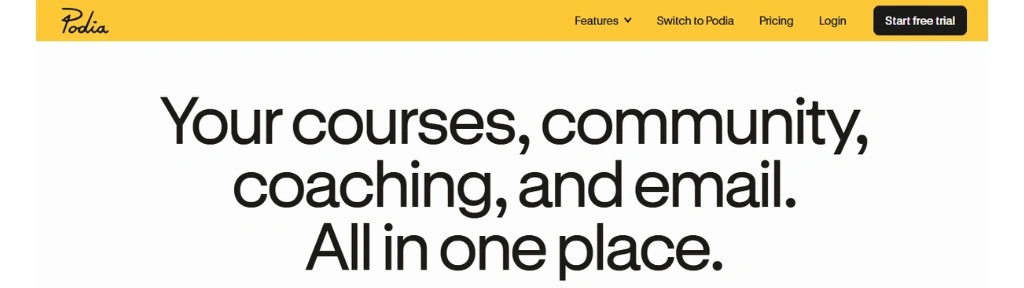
Podia brings your courses, community, coaching, email, and digital products all in one place — with a deliberately simple, human-first philosophy summed up by their own positioning: “for creators who believe the human stuff still matters.”
Trusted by 15,000+ creators who’ve earned $900M+ on the platform, with notable names including Harry Connick Jr., Justin Jackson (co-founder of Transistor.fm), and Bee Varga.
2. Course Building & Student Experience
Podia covers self-paced online courses with drip lessons, quizzes, certificates, and unlimited students — alongside 1:1 and group coaching with built-in client booking and payment, live events and webinars with replay hosting, community spaces with topic channels, group chats, and DMs, and digital downloads.
A website builder with pages, blog, custom domain, and your own fonts and colors rounds it all out — everything from first impression to paid student managed in one dashboard. There’s no AI course builder or gamification layer — Podia’s bet is on simplicity and reliability over feature depth.
3. Marketing & Monetization Tools
Built-in email marketing with newsletters, welcome sequences, and automations is included on all plans — though email is free only up to 100 subscribers, with additional subscriber tiers billed separately.
Affiliate marketing and Zapier actions are locked to the Shaker plan and above — a meaningful gap for Mover users who rely on referral programs or automation workflows. Payment plans, coupons, and bundles are included on all tiers. Free migration assistance is included for Shaker annual customers.
4. Pricing Model
Three paid plans: Mover at $49/month ($42/month annually) with a 5% transaction fee, Shaker at ~$84/month (annually) with 0% transaction fees plus affiliate marketing and Zapier, and Earthquaker at ~$150/month (annually) with unlimited products, videos, community spaces, and 0% fees.
A 30-day free trial — one of the longest in the creator-platform category — requires no credit card. Note: Podia removed its free plan in October 2024, replacing it with this trial. Verify current plan names and figures at podia.com/pricing before committing, as third-party sources show some variation.
The transaction fee on Mover is the critical number to watch — at $2,000/month in sales, that 5% fee adds $100 on top of the plan cost, effectively doubling your monthly platform spend before you reach Shaker’s break-even.
5. Limitation / Verdict
Podia’s gaps are real: no AI course builder, no learner mobile app, no gamification, no SCORM support, and affiliate marketing locked behind the $84/month Shaker plan.
The Mover plan’s 5% transaction fee is one of the more punishing entry-level fees on this list — it compounds fast with revenue and makes the Shaker plan the more honest starting point for anyone actively selling.
There’s also no permanent free tier for creators who want to test before committing financially. That said, Podia’s 30-day trial is the most generous on this list, and its support reputation — consistent, responsive, and human — stands out in a category where support quality often falls apart at scale.
⭐⭐⭐⭐ — The most elegantly simple all-in-one platform here, and one of the most trusted by working creators. Not the deepest on features, not the cheapest on entry, but one of the most reliable for the long haul — especially for creators who value simplicity and a clean platform they’ll actually enjoy using every day.
Teachable
Best for creators who want the most established, globally trusted course platform — with automatic tax handling in 45+ countries, AI subtitle translation into 70+ languages, and a brand track record that reassures students before they even click “Enroll.”
1. What it specializes in
Join 150,000+ creators and businesses using the top online course platform to sell courses, coaching, and digital products — with $10B+ earned by Teachable and Hotmart creators combined, 100M+ students served, and operations across 180 countries.
Part of Hotmart Company, positioning itself as the #1 worldwide leader in the creator economy. Covers online courses, coaching, digital downloads, and memberships in one platform — with a 2026-launched Teachable Payments system as its most significant recent upgrade.
2. Course Building & Student Experience
An AI Course Starter generates ready-to-use curriculums in seconds. An AI Quiz Generator flips course content into quizzes automatically.
Auto-generated subtitles and translations into 70+ languages make content instantly more accessible and marketable globally.
Quizzes, drip content, completion certificates, and a highly rated native iOS and Android learner app are included on all plans — the app being Teachable-branded, not white-label.
The student dashboard is consistently praised for its clean, intuitive experience by creators from Dan George (10,000+ pilots worldwide) to Leila Gharani (students across 188 countries).
3. Marketing & Monetization Tools
Automated upsells and order bumps, coupons, flexible payment options, cross-promotional tools, and 35+ local payment methods are built in via Teachable Payments. Automatic sales tax, VAT, and GST collection and remittance across 45+ countries is handled on all plans — a feature that alone saves global creators enormous administrative overhead.
Affiliate marketing unlocks at the Growth plan ($139/month annual). Daily payouts with no reserve held back is a standout for cash flow compared to competitors that batch payments weekly or monthly.
4. Pricing Model
Four paid plans on annual billing: Starter at $29/month, Builder at $69/month, Growth at $139/month, and Advanced at $309/month. Monthly billing runs $39, $89, $189, and $399 respectively.
Annual billing saves 22–26% across tiers. No free plan — Teachable retired its free tier in early 2025, replacing it with a 7-day free trial (credit card required) and a 30-day money-back guarantee on annual plans.
The critical pricing detail: the Starter plan carries a 7.5% transaction fee that stacks on top of payment processor fees — the break-even between Starter and Builder is roughly $533/month in revenue, above which Builder is cheaper.
Starter also caps at 5 published products and 100 students — limits that actively earning creators typically hit quickly.
5. Limitation / Verdict
Teachable has no built-in email marketing, no native community features, and no white-label mobile app — gaps that all-in-one competitors like FreshLearn and EzyCourse cover at lower price points.
The Starter plan’s 7.5% fee and tight product/student caps mean the real starting point for most selling creators is the Builder plan at $69/month annual — a higher honest entry price than the headline $29 suggests.
The 7-day trial (versus competitors’ 14–30 days) is also the shortest on this list. That said, Teachable’s global infrastructure — automatic tax in 45+ countries, 70+ language translation, Teachable Payments with 35+ local payment methods, and daily payouts — is unmatched by any newer platform here.
For creators who want to reach 180 countries without hiring a tax lawyer or building a payment stack from scratch, Teachable remains the clearest choice.
⭐⭐⭐⭐½ — The most globally battle-tested platform on this list. Not the cheapest or most feature-dense, but the one most likely to still be running exactly as expected in five years — with your global tax compliance handled automatically while you focus on teaching.
Note:
The pricing information for these platforms may be subject to change over time. Therefore, we recommend checking their respective websites for the most up-to-date and accurate information regarding pricing.
- Also note that the information may have changed since the publication.
Conclusion
The best online course platform isn’t the one with the longest feature list — it’s the one that fits where you are right now and where you’re heading next.
Starting out? FreshLearn and Podia offer the gentlest learning curves with honest pricing.
Building a community-first business? Skool leads on engagement.
Need the deepest student experience? LearnWorlds is unmatched.
Selling to professionals at premium prices? Maven is your stage.
And if you want to own your entire stack without recurring fees, Pinlearn or EzyCourse make a compelling case.
One rule before you commit: calculate the true monthly cost — subscription fee, transaction fees, and the tools you’ll need to add on top.
The cheapest headline price rarely reflects what you’ll actually pay at month three.
Your knowledge is the product. Choose a platform that treats it that way.